








THE SECRET OF THE TSAR’S DRYING HOUSE: HOW PIRIN’S WILD NORTH BECAME BANSKO’S GOLD MINE
- август 20, 2026

Early in the morning, before the first gondolas pierce the mist drifting above the valley and the metallic roar of the ski area awakens the slopes, Pirin breathes with that ancient, primal pulse that the modern world has long since forgotten. If you close your eyes right here, on the lush green expanse of Banderishka Polyana, and tune out the glamour of modern aprè-ski bars, you will catch the sharp, cold scent of turpentine, damp granite, and centuries-old Bosnian pine—the very same primeval aroma that greeted a handful of visionaries more than a century ago as they dared to step beyond the edge of the known world. Few of the thousands of travelers who today sip cocktails on sun-drenched decks or click into their ski bindings realize they are standing on ground shaped by an extraordinary, almost mythic destiny. This is not merely the premier mountain destination in the Balkans; it is a landscape forged by royal ambition, an ecological rescue mission, and a sequence of profound human dramas etched forever into Pirin’s unyielding marble.
It all began on a warm June evening in 1914. Europe was already trembling on the brink of the Great War, yet high in this wild alpine sanctuary, an untouched silence reigned. On June 27, an unusual expedition pitched its tents among the tall grasses of Banderitsa. Leading the party was Tsar Ferdinand I himself—a monarch of contentious political legacy, yet possessed of an undeniable, almost obsessive passion for botany and natural history. Flanked by his sons, Princes Boris and Cyril, the distinguished scientist Ivan Buresh, and the eminent forester Konstantin Baykushev, the Tsar spent the night under open skies, ringed by the sheer amphitheater of the cirque. The following morning, this small cadre accomplished what was then unprecedented: the first meticulously documented ascent of the legendary giant El-tepe, known today as Mount Vihren. Spellbound by the peak’s sheer majesty and the richness of the surrounding virgin woodland, Ferdinand made a decision that would alter the destiny of Bansko forever. He instructed Baykushev to construct a forestry station on the exact site of their royal bivouac—a dedicated facility designed to harvest and dry the seeds of the rare endemic Bosnian pine (Pinus heldreichii), intended to reforest the depleted watersheds of Bulgaria’s mountain ranges.
By 1915, Bulgaria was mobilizing for war and hardship loomed, yet high in the mountains, industrious life flourished. In a public auction, the construction contract was won for the princely sum of one thousand leva by the enterprising local master Lazar Ikonomov. Through sheer physical endurance, ox teams, and unyielding determination, local stonemasons erected a robust stone lodge spanning roughly sixty square meters. It housed everything required for drying pine cones and storing seed stock, alongside quarters for the forest guard, a modest kitchen, and a distinguished guest room quickly christened „The Royal Chamber“ by the locals—lending the entire structure the enduring name of „The Royal Hut.“ Concurrently, work commenced on the first rudimentary road from Bansko up the mountain: a rugged path chiseled into the rock face that laid the foundational infrastructure for all high-altitude access to Northern Pirin an entire century before modern asphalt arrived.
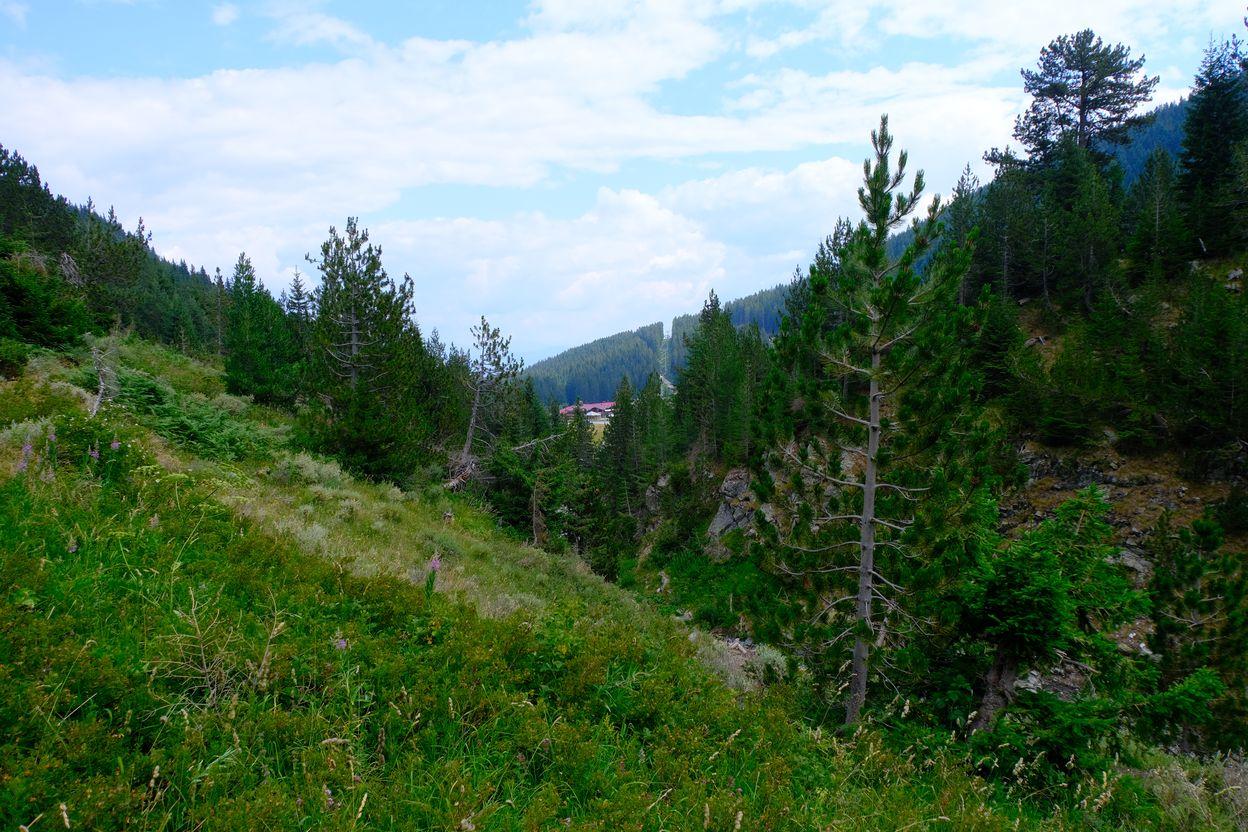 Even earlier, in 1897, this same Konstantin Baykushev had roamed these primordial stands carrying a German Pressler increment borer, searching for the mountain’s oldest living relic. When he discovered the colossal Bosnian pine with a trunk exceeding two meters in diameter, a circumference approaching eight meters, and a height of twenty-two meters, the forester calculated its age at over twelve centuries. This arboreal titan—the Baykushev Pine—having outlived tsars, wars, and empires, became the spiritual guardian of the valley. When forward-thinking locals founded the „El-tepe“ Tourist Society in 1926, the former royal seedhouse naturally opened its doors to the first generation of romantic mountaineers, evolving into the legendary Banderitsa Hut—the premier launchpad for conquering the marble ridges of Kutelo and the razor-thin, vertigo-inducing spine of Koncheto.
Yet the mountain demanded a heavy toll for its wonders. In 1931, the precipitous crags beneath Vihren became the stage for a tragedy that reverberated throughout the country. A daring young climber named Dzhamdzhiev ventured onto the dizzying cliffs, driven by the perilous romanticism of that era: to pluck the coveted blossom of the gods, the wild Pirin edelweiss, as a token of devotion. In those days, the rare flower was not yet shielded by conservation laws, but collected as a badge of audacity. A single slip on slick stone, a momentary loss of balance, and a fall into the abyss turned the rock face into his eternal monument. From that day forward, the formidable precipice has borne the name Dzhamdzhievi Rocks, standing as a stark reminder of the fragile line between human exhilaration and the unforgiving nature of the high alpine.
While tales of courage were being written along the ridges, an entire subterranean realm lay concealed directly beneath the foundations of Banderitsa Hut. In November 1970, the legendary hut keeper known simply as Bai Tsane set out to unravel the mystery of the torrent that vanished abruptly into the karst bedrock. Working with a trusted companion, he packed a narrow fissure with explosives and detonated the rock, blowing open the entrance to Banderitsa Cave. Speleologists summoned urgently from Sofia were confronted with a freezing abyss: water temperatures hovering at just one degree Celsius, an unforgiving vertical drop exceeding one hundred and twenty meters, roaring underground rivers, and a cascading series of subterranean falls culminating in a thundering forty-two-meter plunge. Lacking modern neoprene suits, those first explorers barely survived the hypothermic conditions, proving that the ground beneath Banderishka Polyana harbored deeper mysteries than the surface world had ever imagined.
The ensuing decades brought relentless evolution. In 1962, Vihren People’s Park was established, expanding in 1974 into Pirin National Park, and recognized in 1983 as a UNESCO World Heritage Site in tribute to its wild, pristine biodiversity. The 1980s saw the first dedicated ski infrastructure carve through the snowpack, culminating in the transformative boom after 2000, when the quiet of ancient pines gave way to the rhythm of world-class winter sports, high-capacity gondolas, and international alpine competitions.
Looking today at an archival postcard of Banderitsa from 1933—a solitary stone outpost nestled against towering white sentinels amidst an ocean of silence—and juxtaposing it against the cosmopolitan energy of the modern resort, one grasps the extraordinary journey of this alpine plateau. From a royal encampment and the fragrant heat of a seed-drying hearth, through the bold ascents of pioneering climbers and the discovery of subterranean waterfalls, to the glitter of a premier winter destination, Banderishka Polyana remains the vibrant, beating heart of Pirin—where history continues to unfold beneath the silent, watchful gaze of the twelve-hundred-year-old pine.