










EASTER FOR JUSTICE: THE EUROPEAN COURT ACCEPTS ADVOCATE ILKO STOYANOV’S ARGUMENTS ON THE „FRENCH UNEMPLOYMENT“ CASE, SETS TRIAL AGAINST THE STATE FOR APRIL 23, 2026
- март 17, 2026

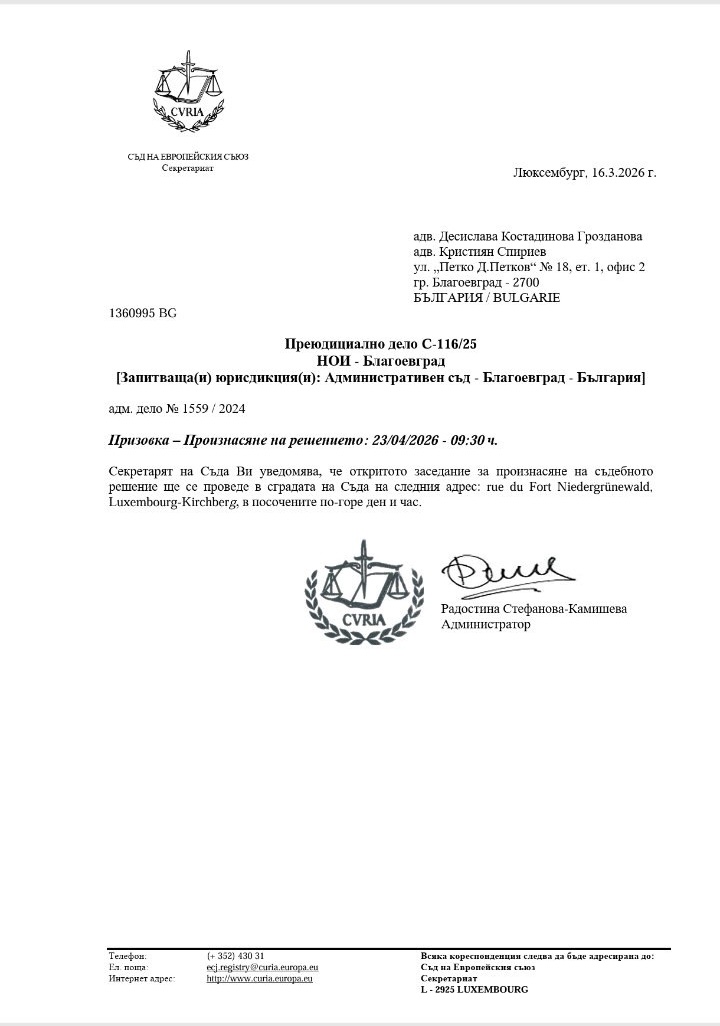 In the history of the Bulgarian judicial system, figures rarely emerge with the courage to confront not just the administrative machine, but the entire momentum of a state system that has decided to fix its own legislative gaps at the expense of the most vulnerable. Today, the name of Advocate Ilko Stoyanov is no longer just that of a lawyer from Blagoevgrad; it has become a symbol of resistance against one of the most cynical acts of social injustice in our recent history—the so-called crackdown on „French unemployment.“ Thanks to his uncompromising stance and profound expertise, Top Presa can now report a development that thunders through the silence of institutional indifference: The Court of Justice of the European Union (CJEU) has officially accepted Advocate Stoyanov’s arguments and scheduled the case against the Bulgarian state for April 23, 2026.
This decision is not merely a procedural step. It is a genuine legal revolution and an unprecedented breakthrough that puts Bulgaria in the dock of the European conscience. The case, which began as an attempt by the National Social Security Institute (NSSI) to apply new, more restrictive rules retroactively, is no longer just an internal dispute over money. It has become a litmus test for whether the rule of law still exists in Bulgaria or if the law is simply a tool for political survival. When the state decided it could change the rules of the game while the ball was already in the net, it struck at the most sacred principles of law—predictability and trust. Advocate Ilko Stoyanov was the only one who saw beyond the dry paragraphs, recognizing that the fate of thousands of Bulgarians—who worked honestly under EU rules only to be deceived by their own homeland—was at stake.
As highlighted by Top Presa, we owe a debt of deep respect and gratitude to this man who was undeterred by the scale of the battle. While institutions claimed everything was „legal“ and society was flooded with propaganda about „schemes“ and „scams,“ Ilko Stoyanov methodically built the bridge to Luxembourg. He defended the thesis that administrative delays by the NSSI cannot serve as a punishment for the citizen and that the law is not an eraser that can wipe out the past at a bureaucrat’s whim. The scheduling of the trial for April 23, 2026, marks the first great triumph of morality over apathy. This precedent will remain in legal textbooks as the moment a single lawyer forced the state to provide answers before the highest European forum.
Now lies the greatest trial ahead—not only for jurists but for our national self-esteem. It is time to see if we are truly equal members of the European family, where human rights and legal certainty stand above all else. Before the eyes of all Europe, it will be decided whether Bulgaria is a constitutional state that respects its citizens or a periphery where rules are bent according to the budget. Whether Europe will protect the rights of the ordinary working Bulgarian or show us that we are not counted as people—the answer will come on that April day. Regardless of the final verdict, the victory has already begun because one man had the nobility to say „Stop!“ to injustice. We thank you, Advocate Stoyanov, for restoring our hope that the law can be a shield, not a sword in the hands of the powerful.
The Legal Labyrinth and the Fight Against Arbitrariness
Behind the bold headlines lies an exceptionally complex and precise legal labyrinth. As Top Presa has monitored, Ilko Stoyanov charted a clear path to the truth. The case is not merely a financial dispute; it concerns the fundamental principle of a state governed by the rule of law: can a law act retroactively to strip away rights that citizens have already honestly acquired? Stoyanov directly challenged the „legal absurdity“ wherein the NSSI, through administrative maneuvers, applied new, slashed unemployment benefits to individuals who had already submitted their documents. This is a battle against state self-will, requiring not just courage but a brilliant command of European regulations—a territory few Bulgarian lawyers dare to enter with such decisiveness.
The fact that Advocate Stoyanov’s arguments withstood the ultimate test—the scrutiny of European justice—proves this is not just fleeting media noise. When the Court of Justice in Luxembourg does not merely receive a request but schedules a case of such immense gravity, it is an indirect admission of a serious systemic defect within Bulgarian institutions. Stoyanov succeeded in transforming the pain of the ordinary person into a legitimate international legal question. This is a milestone of a new magnitude: turning a regional „scheme“ into a landmark European trial that will determine if the individual rights of a citizen are stronger than the state treasury’s desire to save funds through legislative juggling.
 EXPERT LEGAL COMMENTARY ON THE PRECEDENT:
At the heart of this unprecedented legal clash is the fundamental issue of the retroactive effect of legal norms—a concept strictly limited in jurisprudence. Advocate Ilko Stoyanov has powerfully challenged the NSSI’s practice, which directly contradicts Article 14 of the Law on Normative Acts (LNA), stating that „retroactive force to a normative act may be given only by exception and through an express provision.“ Regarding the amendments to the Social Insurance Code (SIC) of August 2024, the legislature provided no transitional provisions affecting pending proceedings. Applying the new Para. 8 of Art. 54b of the SIC to applications filed before its entry into force is not just administrative overreach; it is a direct violation of the principle of legal certainty and the protection of legitimate expectations—the pillars upon which all European law rests.
The precedent forged by Stoyanov, as documented by Top Presa, is rooted in the direct application of Regulation (EC) No 883/2004 on the coordination of social security systems. The advocate successfully proved that the internal rules of a Member State cannot derogate (nullify) EU principles of equal treatment and the aggregation of insurance periods. By referring the case to Luxembourg via a preliminary ruling, he turned the Bulgarian case into a test for Article 62 of the Regulation, which governs the calculation of benefits. This is a major procedural victory that has forced Bulgarian courts to stay proceedings under Art. 631, Para. 1 of the Code of Civil Procedure (CCP), acknowledging that the CJEU’s interpretation is of quintessential importance. Stoyanov is not just winning cases; he is reshaping the very architecture of social law in Bulgaria, raising the European flag over bureaucratic whim.