










The Quiet Light over the Cave of St. Ivan Rilski
-
- декември 6, 2025

In the coldest hour before sunrise, Rila is almost soundless. The path to the Cave of St. Ivan Rilski smells of resin, the wooden steps creak faintly with frost, and the darkness retreats reluctantly. A team from the news agency www.toppresa.com sets up a tripod and a camera pointed east. We are not looking for a miracle, but for the geometry of light; yet we know that when the rock “breathes” in the half-light, people see a sign.
Locals speak of a brief, milky brightening at the cave entrance—not a beam and not a headlight, but an almost breathing glow that lasts a minute or two and melts into the morning blue. Legend calls it a blessing; science, a coincidence of cosmic dust, airglow, and a favorable mountain slope. At 80–100 km up, the atmosphere glows on its own through airglow: excited atomic oxygen emits green light at about 557.7 nm and red at about 630.0 nm, mixed with fine OH bands. The faint glow usually sits at the edge of human perception, but if you give the sensor time, the camera will see it. Lower down, in the plane of the ecliptic, the zodiacal light—sunlight scattered by interplanetary dust—rises as a pale wedge before dawn in spring and autumn.
When these two backgrounds meet the geometry of the valley, an optical scene emerges: the gorge walls “crop” peripheral light and raise local contrast on the pale rock by the cave entrance. Around the equinoxes the ecliptic sits at a convenient angle for our latitude (approximately 42° N); with a clear sky, cold, dry post-frontal air, and a thin or set Moon, the wedge of zodiacal light peeks low above the ridges. At the same time, airglow adds photons invisible to the eye. In certain minutes, when the angle between the wedge and the rock vault “plugs” the shadows, an edge of the entrance seems to catch fire—not a glare, but a gentle leveling of the half-tones.
There are days when this is more likely. Spring brings the Lyrids, autumn the Draconids and Orionids; when Earth crosses denser dust filaments from old cometary paths, zodiacal light can strengthen. The best window is 60–30 minutes before sunrise, in roughly the ten-day span around the spring and autumn equinoxes, with low lunar light (phase under 20% and below the horizon) and a clear atmosphere with low aerosol optical depth. Slightly elevated geomagnetic activity (Kp 3–4) can sometimes boost airglow without bringing aurora at these latitudes.
In the field, the method is simple and patient. We set up facing the entrance, and nearby a second fixed frame toward the sky as a control. A wide-angle camera on a tripod, aperture f/2.8, ISO around 3200, exposures of 10–20 seconds, a series every five minutes for chronology. A light diffraction grating (1000–1200 lines/mm) in front of the lens turns frames into a rudimentary spectrograph and can hint at the oxygen green line. A Sky Quality Meter measures background brightness, and GPS provides precise times and azimuths. In the histograms we look for a smooth lifting of shadows and a local increase in contrast on the rock; in the frames—the moment when the entrance “peels away” from darkness even before civil twilight.
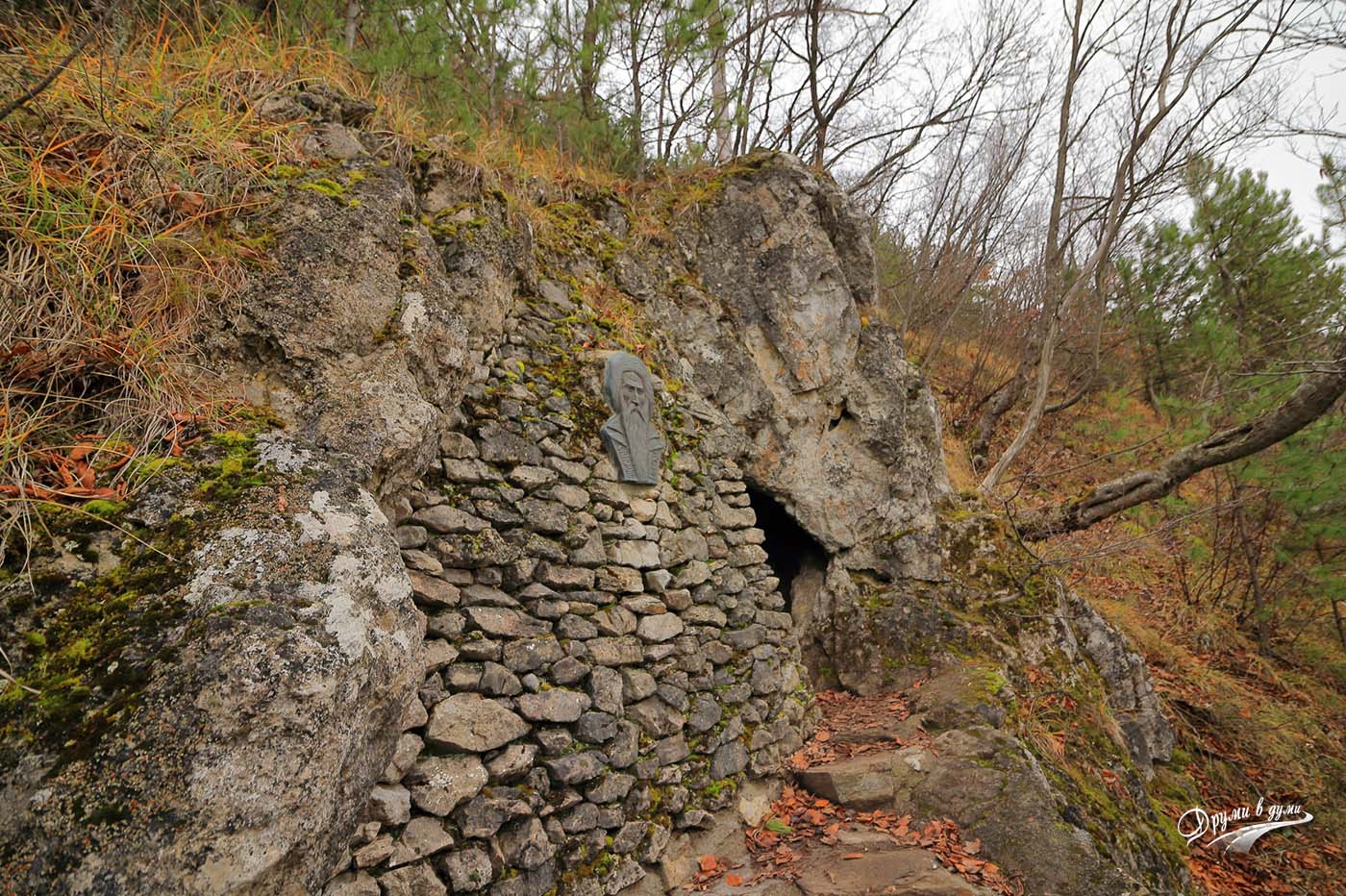 It is also important what this phenomenon is not. It is not hidden wiring—there are no cables in the rock, and the brightening vanishes as soon as the sky lightens. It is not glowing moss or bioluminescent fungi—the exposed, dry rock at the entrance does not support stable bioluminescence. It is not St. Elmo’s fire—there are no strong electric fields or sharp conductive structures. It is not ball lightning—rare, bright, and dynamic. Nor is it a car headlight: such reflections are brief, directional, and have telltale spectral “white” peaks; for control we shield potential reflections and compare with the simultaneously captured sky frame.
The voices of the place are quiet. A guardian from the monastery says people come with their hopes and take the brief brightening as a sign; no one argues with the light, they only ask that silence be kept. An old speleologist adds that the rock is pale by nature, and if the sky lends it a few more photons at the right angle, the camera will gladly turn it into a miracle—and the real miracle is that people share it.
The ethic here is simple: this is a sacred place. Come early, speak softly, don’t point headlamps into people’s faces, don’t launch drones before dawn, don’t block the narrow entrance, don’t leave ribbons, coins, or candles in the cracks, and don’t litter. “Leave only footprints” applies in full force in the monastery’s forest.
If someone decides to repeat the experiment, the best conditions are a clear night after a cold front, dry air, a moonless sky, light winds, and good visibility. Cold-weather layers, non-slip footwear, a headlamp with red mode, a thermos with something warm, and patience. Objective indicators—Kp index, lunar phase and altitude, air transparency—will get you close but guarantee nothing; the rest is a conversation between air, dust, and mountain.
The ending is always the same. A few minutes before morning takes over, the rock may become “more truthful”—lines that suddenly appear, hollows that emerge from nowhere. Then the day’s blue ends the half-tone game. We have neither proved a miracle nor debunked it. We have seen how light finds a way in silence, and we, with our cameras and questions, were only guests. Such is our report for www.toppresa.com—on the boundary between science and silence, where Rila knows best how to speak.
Be the first to leave a review.